

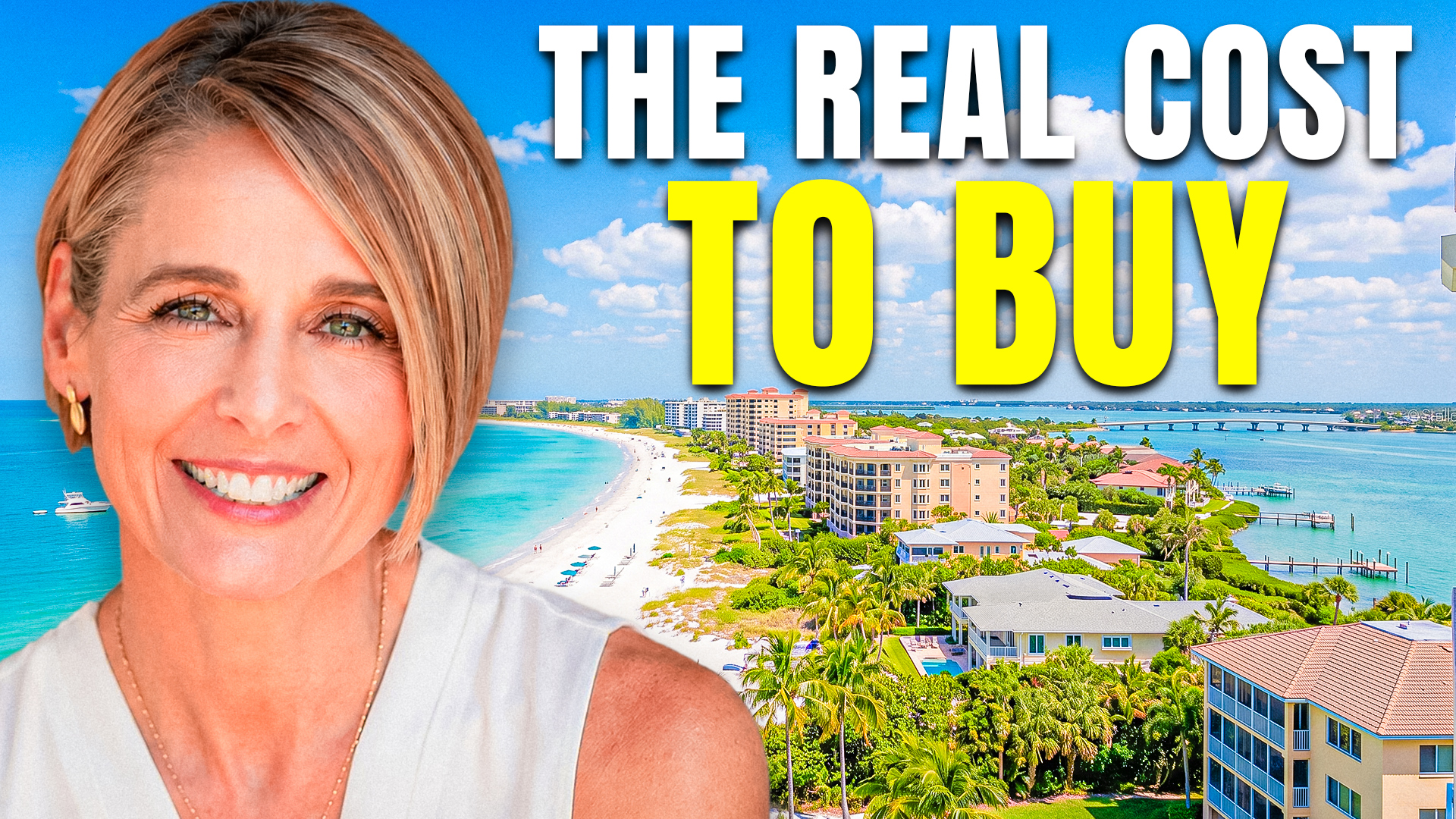
When people think about moving to Longboat Key, Florida, the first number they usually consider is the price of the home.
But the purchase price only tells part of the story.
Living on a barrier island comes with expenses that buyers—particularly those relocating from outside Florida—may not anticipate. Homeowners insurance, flood insurance, property taxes, maintenance, and condominium fees can significantly change the true cost of owning property on Longboat Key.
Understanding these expenses before you buy can help you determine not only how much home you can afford, but how much you are comfortable spending each month to maintain the lifestyle you want.
So, what does it really cost to own a home on Longboat Key?
Let’s break it down.
The Entry Price: What Does It Cost to Buy on Longboat Key?
Online median sale prices can be somewhat misleading when you’re trying to determine what you’ll actually spend for a home on Longboat Key.
That’s because those statistics combine very different types of properties—from smaller and older condominiums to inland villas, waterfront homes, and luxury Gulf-front estates.
If you’re looking specifically for a single-family home, your expectations may need to be considerably different from the island’s overall median sale price.
In today’s market, a realistic starting point for a single-family home may fall somewhere in the $1.4 million to $1.8 million range, depending upon the home’s age, condition, location, water access, and other factors.
Properties offering premium Gulf-front, bayfront, or boating locations can quickly move well beyond $2 million.
For purposes of understanding the potential carrying costs, let’s use a $1.5 million single-family home as our example.
As you’ll see, the purchase price is only the beginning.
Mortgage Costs in Today’s Interest Rate Environment
Interest rates have dramatically changed the affordability equation from several years ago, when buyers could secure mortgage rates in the 3% range.
For our example, let’s assume a 6.5% interest rate on a 30-year fixed mortgage.
On a $1.5 million home with a 20% down payment:
Purchase price: $1,500,000
20% down payment: $300,000
Mortgage amount: $1,200,000
Estimated principal and interest: approximately $7,585 per month
That’s more than $91,000 per year in principal and interest alone.
And we’re just getting started.
Homeowners and Flood Insurance on Longboat Key
Insurance is one of the most important expenses to investigate when purchasing a home on Longboat Key.
Coastal Florida properties can carry substantially higher insurance premiums than properties in many other parts of the country, and the cost can vary tremendously from one home to another.
The age of the home, roof, elevation, construction type, hurricane protection, proximity to the water and other factors can all affect insurability and premiums.
For some higher-risk single-family homes—particularly older properties or homes with direct waterfront exposure—combined annual insurance costs can potentially range from $12,000 to $35,000 or more. Certain properties may receive even higher quotes.
Buyers also need to understand hurricane deductibles.
A Florida homeowners policy may have a separate hurricane deductible calculated as a percentage of the home’s insured value. A 2% hurricane deductible on $1.5 million of insured value, for example, would equal $30,000.
Then there is flood insurance.
Longboat Key is a barrier island, so flood zones and the elevation of an individual property matter considerably. Buyers financing their purchase may also be required by their lender to maintain flood insurance.
One of the most important things you can do during your due diligence period is obtain insurance quotes for the specific property you’re considering.
Don’t assume the seller’s current premium will be your premium. Your coverage and costs as the new owner may be very different.
Property Taxes: Don’t Base Your Budget on the Seller’s Tax Bill
Property taxes are another area where buyers can easily underestimate their future expenses.
Longboat Key has an unusual characteristic: the island spans two counties.
The northern portion is located in Manatee County, while the southern portion is located in Sarasota County. As a result, the total property tax rate can differ slightly depending upon where on the island the home is located.
There is another important consideration for buyers.
The property tax amount shown on a current listing reflects the seller’s situation—not necessarily what you will pay after purchasing the property.
This can be particularly important with a longtime owner whose taxable value may have benefited from Florida’s Save Our Homes assessment limitations and homestead exemptions.
For a $1.5 million non-homesteaded property, an estimated annual tax bill might fall in the range of approximately $20,000 to $23,000, depending upon location, assessed value and applicable millage rates.
Using $21,600 annually for our example adds approximately $1,800 per month to the cost of ownership.
Buying a Condo? Pay Close Attention to Fees and Reserves
A condominium may offer a lower purchase price than a single-family home, but that doesn’t necessarily mean your monthly carrying costs will be low.
Many waterfront and luxury condominium communities on Longboat Key have substantial association fees. Depending upon the community and amenities, monthly fees can range from approximately $1,200 to more than $2,500, with some communities exceeding that amount.
Those fees may cover expenses such as building insurance, landscaping, pools, security, common-area maintenance and other amenities.
But buyers also need to look beyond the monthly fee.
Changes to Florida condominium laws following the Miami Surfside tragedy have placed increased emphasis on structural inspections and adequate reserve funding for certain condominium associations.
Structural Integrity Reserve Studies, commonly called SIRS, and reserve requirements can have a significant financial impact on condominium associations and their owners.
For some associations, addressing deferred maintenance and reserve funding has resulted in higher monthly fees or significant special assessments.
This is why buying a condominium isn’t simply about evaluating the unit itself.
You’re also buying into the financial health of the condominium association.
Before purchasing, carefully review the association’s financial statements, budget, reserves, meeting minutes, inspection reports, SIRS when applicable, pending projects, and history of special assessments.
A surprisingly low monthly condominium fee isn’t always a bargain. Sometimes it warrants a closer look at how well the association is funded for future expenses.
Don’t Forget the “Salt-Air Tax”
There is another expense that doesn’t appear on your mortgage statement or property tax bill.
I whT I call the “salt-air tax.”
It’s one of the realities of owning property near the Gulf of Mexico.
The same environment that makes Longboat Key so beautiful—the salt air, sunshine, humidity and proximity to the water—can also be hard on a home.
Metal corrodes. exterior finishes deteriorate. HVAC systems work hard. Outdoor fixtures, windows, doors and mechanical equipment can require more frequent attention than they might farther inland.
A commonly used guideline for home maintenance is to budget approximately 1% of the home’s value annually.
For a $1.5 million home, that would mean setting aside $15,000 per year, or approximately $1,250 per month.
For an older coastal home, budgeting more conservatively may be wise.
Waterfront properties can also have expenses that aren’t relevant to typical inland homes. Seawalls, docks, boat lifts, hurricane-rated windows, roofing and other coastal components can represent substantial future investments.
Setting money aside for these expenses helps prevent an inevitable repair from becoming an unexpected financial burden.
So, What Is the True Monthly Cost of a $1.5 Million Longboat Key Home?
Now let’s put the major expenses together.
Using our hypothetical $1.5 million single-family home with 20% down:
- Principal & interest: approximately $7,585/month
- Homeowners & flood insurance: approximately $1,500/month
- Property taxes: approximately $1,800/month
- Maintenance reserve: approximately $1,250/month
Estimated Total: $12,135 Per Month
That works out to approximately $145,620 per year in estimated carrying costs.
And remember, this example still doesn’t include utilities, landscaping, pool maintenance, pest control, HOA fees if applicable, or the everyday expenses associated with maintaining the property.
It also assumes an $18,000 annual insurance expense. A property with substantially higher insurance premiums would obviously change the equation.
Can You Afford Longboat Key?
The better question may be: What does “afford” mean to you?
Qualifying to purchase a $1.5 million home and being comfortable carrying that home year after year are two very different things.
Longboat Key offers something that’s increasingly difficult to find—a beautiful barrier-island community with gorgeous beaches, boating access, waterfront neighborhoods, luxury condominiums, and convenient access to St. Armands Circle and downtown Sarasota.
For the right buyer, that lifestyle can absolutely be worth the cost.
The key is understanding the entire financial picture before you fall in love with the house.
If you’re considering buying a home or condominium on Longboat Key, look beyond the asking price. Understand the property’s insurance costs, estimated taxes after purchase, association finances, potential assessments and anticipated maintenance.
Because when you know the numbers before you buy, you can make your decision based on more than whether you can purchase the property.
You can decide whether it’s a property you’ll be comfortable owning for years to come.
Thinking About Moving to Longboat Key?
Longboat Key isn’t one-size-fits-all. The right property depends on the lifestyle you want, the location you prefer, and the investment you’re comfortable making to enjoy it.
If you’re considering relocating to Longboat Key, purchasing a second home, or exploring the island’s different neighborhoods and condominium communities, I’d be happy to help you understand not only what’s available—but what ownership may realistically look like after closing.